


Ber Months Guide: Mindful, Yogic, and Ayurvedic Practices for September Through December
How September, October, November, and December Can Become a Season of Reflection, Balance, and Personal Growth
TL;DR: The Ber Months in a NutshellThe Ber Months—September through December—are an invitation to move with the season instead of rushing toward the end of the year. Through mindfulness, yoga philosophy, and Ayurveda, these four months can become a practice of self-awareness and intentional growth: ground in September, release in October, nourish in November, and simply be in December. Pay attention to what your body, mind, and life are asking for, adjust your routines with the changing season, and remember—you don’t have to finish the year stronger. You can finish it more aware. Want to take the practice deeper? Download our free Ber Months Journal, with guided reflections centered around the four cornerstones of Health, Love, Work, and Play. |

There is something distinct about the months that end in “-ber.” September arrives with a subtle shift as summer begins to soften, routines return, the days gradually shorten, and the year seems to begin turning inward. October brings visible reminders of change, while November invites gratitude, gathering, and reflection. By the time December arrives, celebration, rest, endings, and the awareness that another year is coming to a close are all woven together.
Together, September through December are often called the Ber Months. While the phrase is playful, these four months can also be viewed as a meaningful season of transition. From a mindfulness perspective, they invite us to slow down and notice what is changing. From a yogic perspective, they remind us to practice presence, non-attachment, contentment, and self-study. From an Ayurvedic perspective, they offer an opportunity to adjust our habits as the qualities of the season shift around us.
Rather than treating the final four months of the year as a countdown to January, we can approach them as a practice in themselves: a season to ground, release, nourish, reflect, and perhaps understand ourselves a little better.
Why Seasonal Transitions Affect Us
Human beings do not exist separately from nature. Our bodies respond to light, temperature, sleep patterns, food availability, movement, stress, and changes in routine. Our emotions are also influenced by our environments, relationships, responsibilities, and expectations. Yet modern life often encourages us to operate as though every month should feel exactly the same.
We may expect ourselves to maintain the same productivity in December that we had in June, or assume that our energy should remain consistent throughout the year. We follow the same workout routines, eat the same foods, keep the same schedules, and become frustrated when our bodies or minds begin asking for something different.
Yoga, Ayurveda, and mindfulness offer another way of understanding these fluctuations. They encourage us to ask, What is happening right now, and how can I respond skillfully to it? That question may sound simple, but it is at the heart of all three philosophies. Instead of resisting every change, we can learn to observe what is happening and respond with greater awareness.
Mindfulness: Learning to Notice Before You React
Mindfulness is the practice of paying attention to what is happening in the present moment with greater awareness. This includes pleasant experiences as well as uncomfortable ones. Rather than immediately judging our thoughts, emotions, sensations, or circumstances, mindfulness creates a small amount of space between what we experience and how we respond.
You might notice that you are tired, that your schedule feels too full, or that you have been more anxious lately. You may realize that you are craving more quiet, missing someone, feeling energized and creative, or comparing yourself to other people. The goal is not to immediately fix every observation. The first practice is simply noticing what is true.
This becomes especially valuable during the Ber Months because this period often contains multiple transitions at once. Weather, routines, daylight, social obligations, family dynamics, spending, eating habits, and holiday expectations may all shift within a short period of time. Mindfulness allows us to meet those transitions with awareness rather than moving through them automatically.

Yoga Philosophy: The Practice Goes Beyond the Mat
Yoga is often presented primarily as a physical practice, but its philosophy extends far beyond postures. The physical poses, or asana, are only one aspect of a much larger system concerned with awareness, behavior, concentration, inner steadiness, and our relationship with ourselves and others.
Several yogic principles are especially useful during the final months of the year. Svadhyaya, or self-study, encourages us to observe ourselves with curiosity. Aparigraha, or non-grasping, teaches us to loosen our attachment to what we no longer need. Santosha, or contentment, reminds us that growth and appreciation can exist at the same time. Ahimsa, or non-harming, can influence the way we speak to ourselves, care for our bodies, and set boundaries.
Yoga therefore becomes less about touching your toes and more about learning how to meet your life. Your yoga mat becomes one place where that practice happens, while your relationships, decisions, routines, expectations, and reactions become the rest.
Ayurveda: Living in Relationship With the Season
Ayurveda, the traditional system of wellness that developed alongside yoga in India, places significant emphasis on living in harmony with changing conditions. One of its foundational ideas is that qualities in our environment can influence similar qualities within us. Cooler weather may increase feelings of coldness, windy weather can contribute to a sense of movement or restlessness, dry environments can increase dryness, and irregular schedules may contribute to irregular sleep, digestion, or energy.
Autumn is commonly associated with Vata dosha, which is connected to the elements of air and space and qualities such as lightness, dryness, coolness, movement, and variability. This does not mean everyone experiences autumn in exactly the same way. Your constitution, climate, health, lifestyle, age, and circumstances all matter.
Ayurveda is ultimately a practice of observation. Rather than blindly following seasonal rules, it asks us to notice qualities and respond to them. If life feels scattered, introduce steadiness. If you feel cold, seek warmth. If things feel overly stimulating, create quiet. If your schedule is unpredictable, establish a few dependable routines. This principle of balancing qualities can guide us beautifully through the Ber Months.
September: Reorient and Ground
September often feels like a second beginning. School resumes, work schedules may change, vacations wind down, projects restart, and people begin reorganizing closets, routines, calendars, and priorities. There is a cultural sense of getting back to business, and that energy can be motivating. At the same time, it can tempt us to overhaul everything at once.
September does not have to become another January. Instead of reinventing yourself, consider using September to reorient yourself. This means taking time to understand where you are before deciding where you need to go.

The Mindfulness Practice: Notice Where You Actually Are
Before deciding what needs to change, look at your life as it currently exists. Ask yourself, What is working for me right now? Then consider, What feels unnecessarily difficult?
This is svadhyaya in action. Self-study is not self-criticism; it is the process of gathering information with honesty and curiosity. Perhaps your mornings feel rushed because you immediately reach for your phone, while your evening routine is working beautifully. Maybe your exercise routine needs adjustment, or perhaps you have been overcommitting socially. You may need more structure, or you may need less.
The answer does not need to be dramatic. September can simply be the month when you begin listening again and paying attention to what your life is already telling you.
The Ayurvedic Perspective: Create Stability as the Season Changes
As late summer moves toward fall, cooler, drier, and more variable qualities often emerge. You may notice increased mental activity, lighter sleep, dryness, inconsistent digestion, nervous energy, or a tendency to feel scattered. This is where the Ayurvedic principle of balancing with opposite qualities becomes useful.
You can create warmth, rhythm, and steadiness through simple choices. Warm meals may feel more grounding than constant cold foods. A regular bedtime may become especially supportive. Warm showers, baths, tea, oil massage, gentle stretching, and quieter evenings can help mark the transition.
You do not need a complicated Ayurvedic routine. Consistency itself can be medicine, especially when the world around you begins to feel more changeable.
The Yoga Practice: Build Your Foundation
September is a good time to return to foundational postures such as Mountain Pose, Warrior I and II, Chair Pose, Low Lunge, Child’s Pose, and Standing Forward Fold. These poses offer something simple but important: contact with the ground.
As you practice, pay attention to your feet and notice where your weight is distributed. Observe whether you are rushing from one posture to the next, and bring awareness to the quality of your breath. A grounded physical practice can become a reminder to ground yourself outside the studio as well.
September’s guiding question is: What helps me feel steady?
October: Release and Simplify
By October, change is harder to ignore. Leaves shift color and fall, daylight shortens, and temperatures change. The natural world begins letting go, making October an ideal month to explore one of yoga’s most useful concepts: aparigraha.

Aparigraha: The Practice of Loosening Your Grip
Aparigraha is often translated as non-possessiveness or non-grasping. It encourages us to notice what we hold onto too tightly. This may include physical possessions, but it can also include expectations, identities, relationships, old goals, resentments, habits, other people’s opinions, and ideas about where we thought we would be by now.
Letting go does not require rejecting your past. It simply asks whether something still belongs in your present. October offers a useful question: What am I carrying because it still serves me, and what am I carrying simply because it is familiar?
Mindful Simplification
Self-growth is often marketed as accumulation: more habits, more books, more routines, more products, more challenges, and more productivity systems. Yet growth can also happen through subtraction.
Maybe you need one fewer obligation, one fewer app notification, or one fewer commitment you secretly resent. Perhaps you need to release an expectation about what your mornings should look like.
Simplifying does not mean doing nothing. It means making room for what matters and creating space for your energy to move toward what is genuinely meaningful.
An Ayurvedic Approach to October
As autumn deepens, Vata qualities may become more pronounced. The season can feel dry, cool, mobile, light, and irregular. In response, Ayurveda traditionally emphasizes warming, nourishing, and grounding qualities.
This might look like cooked breakfasts, soups, roasted vegetables, grains, warm beverages, or warming spices that work well for your body. External oiling practices such as abhyanga, or self-massage with oil, are also traditionally used during drier seasons.
Your mental environment deserves attention as well. Too much information can create its own kind of dryness and restlessness. Constant scrolling, news, podcasts, notifications, emails, and background television all contribute to sensory input. Your mind needs periods without input, and silence can be nourishment too.
Yoga for October: Soften Instead of Strive
October can be a good time to slow your physical practice by including longer forward folds, gentle hip openers, twists, supported poses, and restorative shapes. Instead of asking, “How far can I stretch?” try asking, Where am I holding more tension than I need?
This is yoga as self-study. You are learning to distinguish effort from unnecessary effort and discovering that softening can sometimes be more transformative than striving.
October’s guiding question is: What would become possible if I stopped gripping so tightly?
November: Nourishment, Gratitude, and Santosha
November is often associated with gratitude, but gratitude can become superficial when it is used to avoid difficult emotions. Real gratitude does not require pretending everything is perfect. You can be thankful and grieving, grateful and tired, content and still wanting change, or connected to some people while feeling lonely for others.
Yoga gives us a philosophy that makes room for this complexity through santosha.

Santosha: Contentment Without Complacency
Santosha is usually translated as contentment, but contentment does not mean settling. It does not require abandoning goals or pretending you do not want anything. Instead, santosha asks whether you can acknowledge what is already here while continuing to grow.
This can be particularly meaningful as the end of the year approaches. November is often when comparison intensifies. Holiday advertising begins, and social media fills with curated homes, gatherings, gifts, outfits, travel, family traditions, and year-end accomplishments. Without noticing it, we may begin asking whether our lives are enough, whether we did enough this year, whether we have enough, or whether we are successful enough.
Santosha interrupts that cycle by inviting us to practice enoughness in the present moment.
A More Mindful Gratitude Practice
Instead of forcing yourself to create a long gratitude list, make your gratitude specific. Ask yourself, What happened today that made my life feel a little softer?
Perhaps someone texted to check on you, your coffee tastes especially good, the weather was beautiful, or you completed something difficult. Maybe you laughed, took a nap, said no when you normally would have said yes, made dinner instead of ordering something, or noticed the sunset.
Specific gratitude helps us actually experience appreciation rather than merely performing it.
Ayurveda and the Idea of Nourishment
November invites us to think about nourishment broadly. Food matters, of course. As temperatures become cooler, warm cooked meals, healthy fats, seasonal vegetables, soups, grains, and warming beverages may feel especially supportive for many people.
But Ayurveda reminds us that everything we take in becomes part of our experience. This includes sensory input, conversation, media, relationships, environment, and rest. Ask yourself, What am I consuming emotionally and mentally?
Perhaps your body is well fed but your mind is overloaded. Perhaps your calendar is full while your emotional life feels undernourished. Nourishment is not only about what is on your plate; it is also about what you allow into your awareness and what gives you the capacity to feel supported.
Yoga for November: Practice Receiving
Yoga practices during November can emphasize support through poses such as Supported Child’s Pose, Reclined Bound Angle, gentle heart openers, Cat-Cow, Supine twists, Legs Up the Wall, and longer Savasana.
There is an important lesson in these practices: you do not always need to hold yourself up. Sometimes practice means allowing yourself to be supported, receiving rest, and trusting that restoration is also a form of progress.
November’s guiding question is: What genuinely nourishes me?
December: Presence, Reflection, and Rest
December tends to amplify everything. There may be celebration, shopping, travel, family, food, traditions, deadlines, decorating, social events, and financial pressure. There can also be grief, loneliness, relief, excitement, and exhaustion. Underneath all of it is the awareness that another year is ending.
This makes December one of the most important months to practice presence.

Mindfulness Instead of Holiday Autopilot
The holidays can become one long sequence of tasks: buying, attending, cooking, sending, finishing, and planning. Before we know it, the month is gone. Mindfulness asks us to interrupt that momentum occasionally.
Before walking into a gathering, take three breaths. Before eating a holiday meal, pause for a moment. When someone is speaking to you, listen without simultaneously checking your phone. When something feels beautiful, experience it before photographing it. When you are tired, notice the tiredness.
These are not dramatic practices, but they are small acts of presence. They are also yoga because they bring you back into direct relationship with the moment you are actually living.
Ahimsa During the Holidays
December is also a useful time to remember ahimsa, the yogic principle of non-harming. We often think about ahimsa in relation to how we treat others, but it also includes how we treat ourselves.
Consider whether you speak harshly to yourself after eating differently than usual, force yourself to attend every event, compare your home or finances to other people’s, or sacrifice sleep to make everything perfect. Practicing ahimsa might mean leaving an event early, setting a budget, saying no, resting, eating without guilt, allowing a tradition to change, or choosing peace over performance.
An Ayurvedic View of Holiday Overstimulation
December can create an interesting contrast. Nature becomes darker and quieter while human schedules become brighter, louder, busier, and less predictable. Late nights, travel, rich meals, socializing, alcohol, screen time, shopping, and irregular routines may all increase at once.
From an Ayurvedic perspective, balance does not require avoiding everything enjoyable. It means responding to excess with awareness. After a late night, perhaps the next morning is slower. After a heavy meal, perhaps the next meal is simpler. After several days of socializing, perhaps you need time alone.
Rather than asking, “How do I do December perfectly?” ask, What would move me one small step closer to balance today? That question is far more sustainable.
Yoga for December: Let Rest Be Yoga
December may be the month when we most need permission to stop treating every yoga practice as a workout. Try restorative poses such as Legs Up the Wall, Supported Child’s Pose, Reclined Bound Angle, Supported Bridge, Supine twists, and Savasana. You might also sit quietly for five minutes and breathe.
That counts. Yoga is not measured by sweat; it is measured by awareness.
December’s guiding question is: Can I let this moment be enough before rushing into the next one?
Four Yogic Themes for the Ber Months
If you want a simple way to carry these teachings with you from September through December, think of the season in four stages. September is a time to ground, using svadhyaya, or self-study, to notice what is working and rebuild the routines that genuinely support you. October is a time to release, practicing aparigraha by loosening your grip on expectations, habits, commitments, and identities that no longer fit.
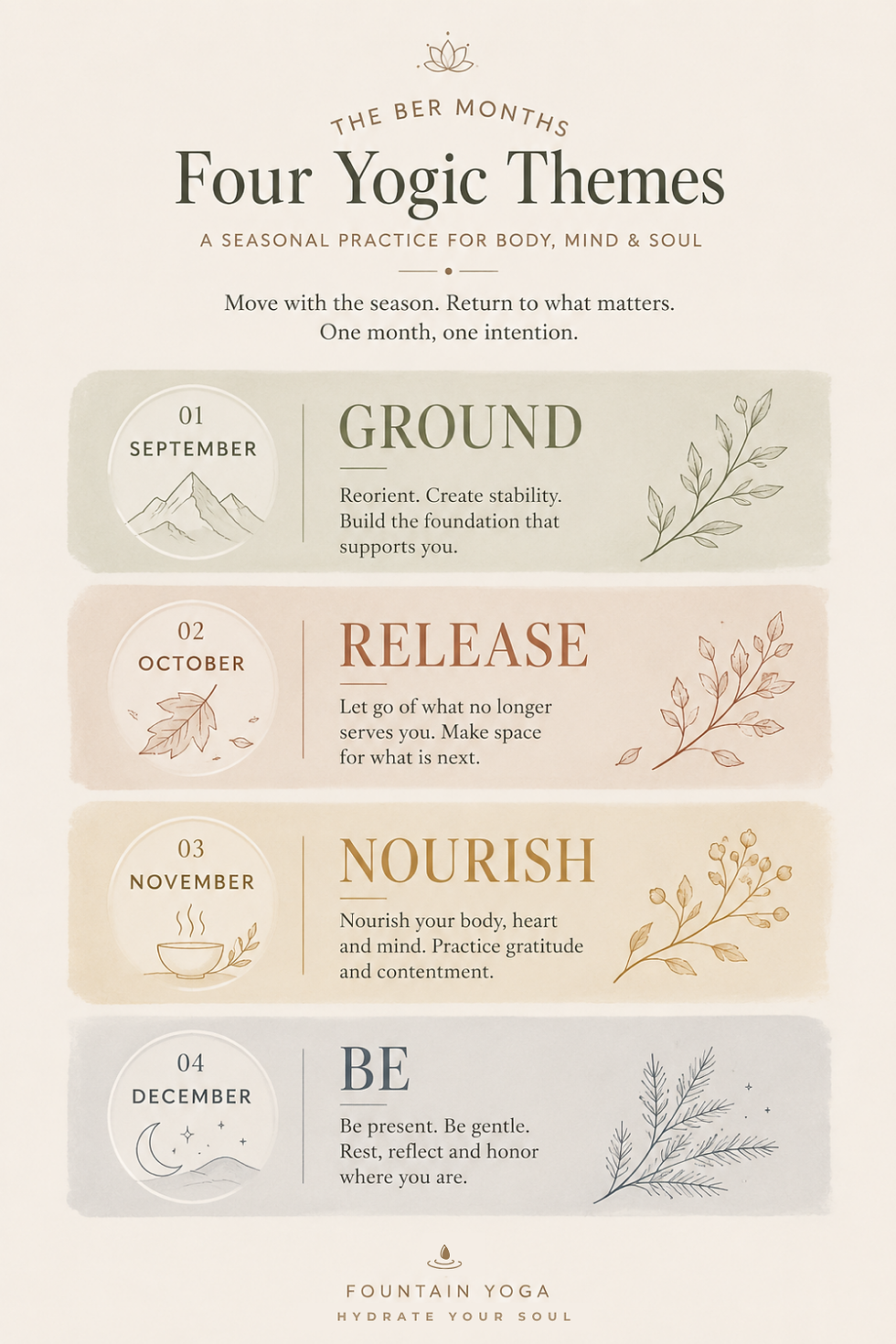
November is a time to nourish, exploring santosha by appreciating what is present while paying attention to what genuinely replenishes your body, mind, and emotional life. December is a time to be, practicing mindfulness and ahimsa by slowing down, reducing unnecessary pressure, and allowing rest and presence to become part of your practice.
Ground, release, nourish, and be. These four ideas are enough to create a meaningful seasonal practice.
Let Your Yoga Practice Change With the Season
Your yoga practice does not need to look exactly the same throughout the year. In fact, one of the most mindful things you can do is allow your practice to respond to your current needs.
September may call for stronger standing postures and a return to routine. October may invite slower transitions and grounding. November might benefit from heart-opening and restorative work. December may ask for longer rest, meditation, and gentler movement.
The important thing is not whether you follow a perfect seasonal sequence. It is whether you are listening. One of the most useful questions you can ask yourself on the mat is, What does my practice need to become today?
Not what you planned yesterday, what someone on Instagram is doing, or what your body could do six months ago. Today. That is yoga.
Ayurveda Is About Awareness, Not Perfection
Ayurveda can sometimes appear complicated, with its doshas, seasonal routines, herbs, spices, food combinations, and daily practices. Beneath all of those details, however, is a remarkably practical idea: Pay attention to qualities and respond accordingly.
If you are cold, add warmth. If you feel scattered, create rhythm. If you are overstimulated, reduce input. If you feel heavy, introduce lightness and movement. If you are dry, add nourishment and moisture. If you are exhausted, rest.
You do not need to follow an elaborate Ayurvedic lifestyle to benefit from this way of thinking. Simply become more observant. Over time, you begin recognizing your own patterns, and that is where Ayurveda becomes personal.
Don’t Turn Mindfulness Into Another Standard You Have to Meet
There is one trap worth avoiding during the Ber Months: turning wellness into another source of pressure. You do not need a perfect morning routine, meditate every day, practice yoga for an hour, cook every Ayurvedic meal from scratch, or journal every morning.
Mindfulness is often much less polished. Sometimes it is realizing that you need sleep. Sometimes it is noticing that you have been scrolling for an hour, recognizing that you said yes when you wanted to say no, or becoming aware that your jaw is clenched. It may be deciding not to respond immediately or getting into bed early.
Awareness does not have to be impressive to be transformative. It only needs to be honest enough to help you respond to your life with greater care.
A Different Way to Reflect on the Year
By December, the pressure to evaluate the year can become intense. We may ask what we accomplished, how much we earned, how productive we were, or which goals we completed. Those questions have their place, but yoga encourages deeper self-study.
You might also ask where you became more honest with yourself, what you learned about your needs, and where you finally established a boundary. Consider what you are no longer willing to tolerate, what became less important, what became more meaningful, and where you chose peace instead of proving yourself. You might reflect on how your relationship with yourself changed and what you are proud of that nobody else can see.
These questions reveal growth that cannot always be measured on a spreadsheet or checked off a goal list. Sometimes that is the growth that matters most.
The Ber Months Are Not Leftover Time
September through December are often treated like the final sprint: four months left, then three, then two, then one. Suddenly, everything becomes about finishing the year strong. But perhaps you do not need to finish strong. Perhaps you need to finish aware.
The Ber Months are not leftover time before January. They are four months of your life, and each one deserves your attention. September deserves your attention. October deserves your attention. November deserves your attention. December deserves your attention.
You do not need to rush toward becoming a new person on January 1. Use these months to become more familiar with the person who is already here. Notice what grounds you, what you are ready to release, what nourishes you, and what deserves your attention. Notice what happens when you stop treating every season as something you need to conquer.
Yoga continually brings us back to the same place—not next month, not next year, not when your routine is perfect, and not when you finally feel organized, but here: this breath, this body, this season, this life.
Namaste.
Continue the Practice with Our Free Ber Months Journal
If you want a simple way to carry these ideas with you through September, October, November, and December, our free Ber Months Journal was created to help you slow down, check in, and stay connected to what matters most.

The journal is centered around four cornerstones: Health, Love, Work, and Play. These areas often reveal where we feel supported, stretched, fulfilled, or out of balance. Each weekly prompt gives you space to notice what is true in your life right now without turning reflection into another obligation.
You may find that Health is asking for more rest or consistency. Love may invite you to look at your relationships, boundaries, and connection with yourself. Work may bring clarity around energy, purpose, or priorities. Play reminds you that joy, creativity, curiosity, and fun are not extras—they are part of a well-lived life.
There is no need to journal every day or have a profound answer each week. The practice is simply to return, notice which cornerstone is asking for your attention, and let your answers evolve as the season changes.
Download the free Ber Months Journal and use it as a companion from September through December—a gentle place to ground, reflect, grow, and move into the new year with greater self-understanding.


